
Average Cost of Professional Roof Cleaning in 2026
Table of Contents
What the Average Cost of Professional Roof Cleaning Looks Like in 2026
National Average vs. Your Actual Quote
Average Cost by Roof Size
Soft Wash Roof Cleaning Cost: Why It Costs More Than Pressure Washing
The Equipment and Chemical Difference
Factors Affecting Roof Cleaning Estimates
Roof Pitch, Height, and Accessibility
Roof Material and Condition
How Often Should You Clean Your Roof?
Material-Specific Pricing: What Different Roof Types Cost to Clean
Asphalt Shingles
Metal Roofs
Tile Roofs (Clay and Concrete)
Wood Shakes and Shingles
Slate
What This Means for Your Quote
The Long-Term ROI of Professional Roof Cleaning
The Mechanism: Why Growth Shortens Roof Life
The Replacement-Cost Comparison
Curb Appeal and Resale
The Insurance Dimension Most Homeowners Miss
How to Frame the Decision
Eco-Friendly Chemical Safety and Insurance Implications
Frequently Asked Questions
Last Updated: September 16, 2026
What the Average Cost of Professional Roof Cleaning Looks Like in 2026
Ask five homeowners what they paid to have their roof cleaned and you'll get five different answers. The average cost of professional roof cleaning in 2026 depends on roof size, material, pitch, and how much organic growth has taken hold, which is why two identical-looking houses on the same street can receive quotes hundreds of dollars apart.
National Average vs. Your Actual Quote
A national average is a useful benchmark and a poor prediction. It blends single-story ranches with steep three-story homes, asphalt shingles with tile, and light algae dusting with embedded moss. Your quote reflects your specific roof, not the country's.
What actually moves your number up or down:
Roof size and square footage, the single biggest driver
Pitch and height, steeper and taller roofs need more safety equipment and time
Material, some surfaces tolerate stronger cleaning solutions than others
Severity of growth, black streaks and moss take longer to treat than light discoloration
Average Cost by Roof Size
Roof cleaning is priced largely by square footage, so size is the first thing a contractor estimates. A small single-story roof takes a fraction of the time, labor, and cleaning solution of a large two-story home.
A few practical rules of thumb:
Smaller roofs sit at the low end of the range
Mid-size roofs land in the middle
Large or multi-story roofs sit at the top, often with added charges for height and access
Pro Tip Ask for a quote that itemizes square footage, pitch, and material separately. Contractors who price by "feel" tend to overcharge steep roofs and undercharge complex ones, and you can't tell which you got without the breakdown.
Soft Wash Roof Cleaning Cost: Why It Costs More Than Pressure Washing
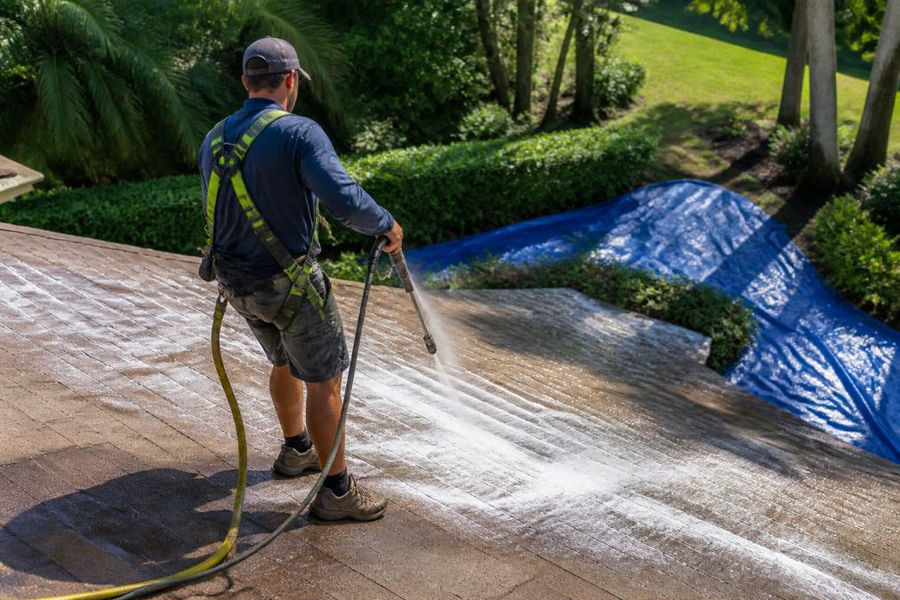
Soft washing costs more than pressure washing because it uses specialized low-pressure equipment and cleaning solutions instead of raw force. Soft washing applies a chemical treatment at low pressure and lets the solution do the work.
The Equipment and Chemical Difference
Soft washing requires proportioning systems, dedicated pumps, and biodegradable cleaning solutions that neutralize algae, moss, and bacteria at the root, more equipment and chemistry than a pressure washer alone, which is why the price is higher.
Watch Out Never let anyone pressure wash an asphalt shingle roof. High-pressure spray strips the protective granules, shortens roof lifespan, and gives manufacturers grounds to deny a warranty claim. If a quote offers "pressure washing" for your shingles, walk away.
Factors Affecting Roof Cleaning Estimates
Several variables separate a low quote from a high one. The main cost drivers are roof pitch, height, accessibility, material, and current condition.
Roof Pitch, Height, and Accessibility
Steep roofs and multi-story homes require fall protection, safety equipment, and slower, more careful work, all of which raise labor costs. Landscaping, tight property lines, and fragile gutters add time. A contractor who quotes a steep three-story roof the same as a flat single-story one is either cutting corners on safety or planning to surprise you later.
Roof Material and Condition
Material dictates which cleaning solutions are safe, and heavier growth means more chemical treatment and repeat applications. A roof with light algae costs less to clean than one buried under moss, regardless of size.
Factor | Effect on Cost | Why It Matters |
Roof size | Higher with square footage | More area, more time and solution |
Pitch and height | Higher when steep or tall | Safety equipment and slower work |
Material | Varies by surface | Some materials need gentler solutions |
Growth severity | Higher with heavy moss | More treatment and repeat passes |
Accessibility | Higher when obstructed | Landscaping and tight access slow crews |
How Often Should You Clean Your Roof?
Most roofs need professional cleaning every two to three years, though shaded roofs and homes near trees may need it more often. Algae and moss return faster in humid climates and on north-facing slopes that stay damp longer.
Material-Specific Pricing: What Different Roof Types Cost to Clean
Most guides hand you one national average and stop. That number is nearly useless, because the material on your roof decides which cleaning method is safe, how long the job takes, and how much solution the crew burns through. Here's how pricing breaks down by material.
Asphalt Shingles
Asphalt is the most common roof surface and usually the cheapest to clean, because it tolerates a standard soft wash: low pressure, a sodium hypochlorite solution, and a surfactant that helps the mix cling to granules long enough to kill algae at the root. Expect asphalt at the low end of the per-square-foot range.
Metal Roofs
Metal costs more than asphalt for two reasons. Standing-seam and corrugated panels have seams, fasteners, and penetrations that trap organic matter and need individual attention. And some finishes, particularly older painted panels and certain coated steels, are sensitive to strong hypochlorite concentrations, so crews dilute the mix and work in smaller sections.
Tile Roofs (Clay and Concrete)
Tile is more expensive than asphalt because the surface is porous and the profile is uneven. Clay and concrete tiles hold moisture in the valleys between courses, exactly where moss and lichen establish. A soft wash still applies, but the crew must saturate more thoroughly and often returns for a second treatment.
Wood Shakes and Shingles
Wood is the most expensive common material to clean, and the reason is chemical, not just labor. Wood shakes are damaged by high pressure and degraded by strong sodium hypochlorite, so crews use gentler, often oxygen-based cleaners at lower concentrations, then rinse carefully. Wood also absorbs moisture, so it needs longer dry time between passes.
Slate
Slate is durable but fragile at the edges and expensive to replace, so cleaning is slow, deliberate, and often done with the gentlest possible method. Many slate roofs are cleaned primarily to remove moss and biological staining rather than heavy algae, and the price reflects the caution required.
What This Means for Your Quote
Material | Relative Cost | Why |
Asphalt shingle | Lowest | Tolerates standard soft wash, fast application |
Metal | Moderate to high | Seams, fasteners, finish sensitivity |
Tile (clay/concrete) | Moderate to high | Porous, uneven profile, brittle underfoot |
Wood shake/shingle | High | Gentle chemicals, long dry time, damage risk |
Slate | High | Fragile edges, slow deliberate work |
Key Takeaway Never compare a quote for your tile roof to your neighbor's asphalt shingle quote. The material changes the method, the method changes the labor and chemistry, and that is what changes the price. Ask any contractor to state in writing which cleaning method and which solution they plan to use on your specific material.
The Long-Term ROI of Professional Roof Cleaning
Roof cleaning is usually sold as a cosmetic service. It's actually a maintenance decision with a measurable financial case, here's the mechanism, the math, and the insurance angle.
The Mechanism: Why Growth Shortens Roof Life
Algae, moss, and lichen don't just sit on the surface. They hold moisture against the roof deck and, in the case of moss, send rhizoids into the gaps between shingles or tiles. That trapped moisture accelerates granule loss on asphalt, freeze-thaw damage in cold months, and rot in wood.
The Replacement-Cost Comparison
A full asphalt shingle roof replacement is one of the largest single expenses a homeowner faces, priced per square (100 square feet) plus tear-off, disposal, underlayment, and labor. Professional cleaning, by contrast, is a recurring maintenance cost measured in the hundreds of dollars for a typical single-family home.
Curb Appeal and Resale
A streaked or mossy roof is one of the first things a buyer, appraiser, or inspector notices. In a resale context, a visibly neglected roof invites repair requests and price negotiations, while a clean roof removes an obvious objection. For commercial property managers, customers judge a storefront by its exterior, and a stained roof reads as deferred maintenance.
The Insurance Dimension Most Homeowners Miss
Homeowners insurance policies generally require the owner to maintain the home and address conditions that could lead to damage. A roof left to accumulate moss and moisture can be characterized as neglect, and neglect-related damage is a common reason claims get disputed or denied. Separately, roof warranties, contracts with the manufacturer, not the insurer, typically condition coverage on reasonable maintenance and proper cleaning methods.
What this means practically:
Keep dated records of professional cleanings, including the method and solution used.
Confirm the contractor is licensed and insured before work begins, and keep the certificate.
Ask your insurer directly whether documented maintenance affects your coverage or eligibility for any maintenance-related discount. Do not assume, policies vary widely.
Watch Out Do not assume your policy rewards maintenance or that it ignores neglect. The only reliable answer comes from your own insurer and your own policy documents. What you can control is the paper trail: dated invoices and method records that show the roof was maintained.
How to Frame the Decision
The honest framing isn't "cleaning pays for itself." It's that cleaning is a low-cost, recurring input that protects a high-cost, long-lived asset, and the alternative, replacement, is an order of magnitude more expensive. For most homeowners, the question isn't whether to clean but how often, and the answer depends on shade, tree cover, and local humidity.
Eco-Friendly Chemical Safety and Insurance Implications
Eco-friendly cleaning matters because runoff from roof cleaning flows into gutters, soil, and landscaping. Biodegradable cleaners and careful rinsing protect plants and pets while still neutralizing the organic growth that causes black streaks.
Frequently Asked Questions
How much should I pay to have my roof cleaned?
The average cost of professional roof cleaning in 2026 typically ranges from $400 to $900 for a standard single-story home, depending on roof size, material, and pitch. Larger homes with steep or multi-level roofs can run $1,000 to $1,500 or more. Soft washing costs more than pressure washing because it uses specialized low-pressure equipment and biodegradable chemical treatments that protect shingles. Always get a written estimate that itemizes labor, cleaning solutions, and any service call fees before you book.
How much is it to soft wash a 2,500 sq ft roof?
Soft washing a 2,500 sq ft roof generally costs between $500 and $1,100 in 2026, with the national average landing around $700 to $850. The price depends on roof pitch, height, shingle type, and how much moss or algae growth is present. A roof with heavy black streaks or thick moss removal may fall at the higher end because it requires more chemical treatment and dwell time. Request a contractor estimate that breaks down the square footage and cleaning method used.
What time of year is best to schedule professional roof cleaning?
Spring and early fall are the best times to schedule professional roof cleaning in most U.S. climates. These seasons offer mild temperatures that allow cleaning solutions to work effectively without evaporating too quickly in summer heat or freezing in winter. Scheduling in spring removes algae growth and moss before the humid summer months accelerate regrowth. Fall cleaning clears fallen leaves and debris from valleys and gutters before winter storms. Many providers book up quickly in spring, so reserve your spot early.
Is professional roof cleaning worth the investment for curb appeal?
Professional roof cleaning is worth the investment for most homeowners because it restores curb appeal and can extend roof lifespan. Black streaks from algae growth, moss, and lichen make a roof look old and neglected. Removing them with a soft wash treatment restores the shingles' appearance and prevents organic growth from holding moisture against the roof surface. Clean roofs also help with resale value and may satisfy insurance requirements. The cost is a fraction of what a premature roof replacement would run.
GET A QUOTE


Comments